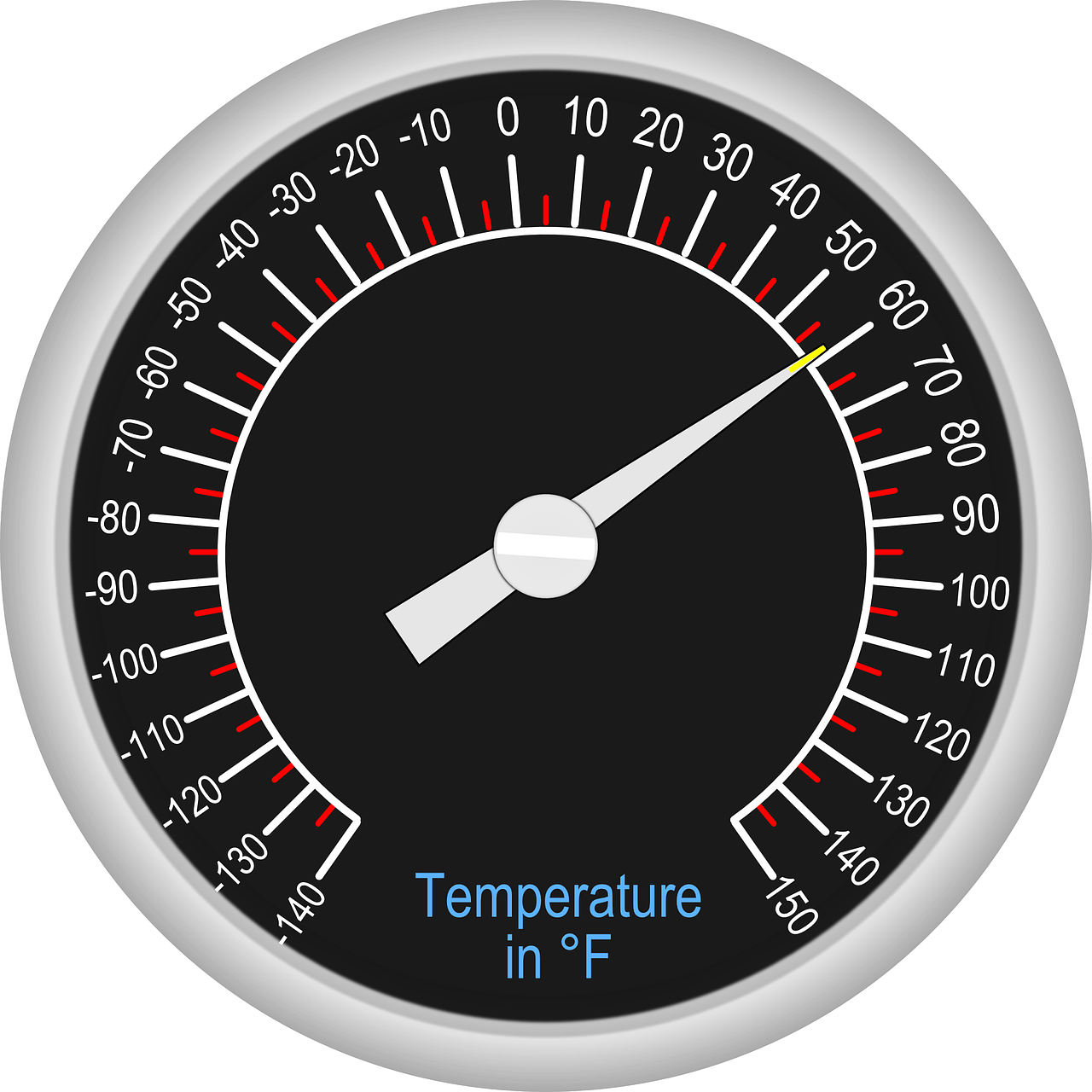
What relationship exists ( if any ) between heat and temperature? The concepts of heat and temperature are akin to the relationship between the number of moles of a substance and the molarity ( M = moles / L ) of an associated solution. Recall that a mole is a quantity of substance ( atoms or molecules ) that contains 6.024 * 10^23 atoms. Molarity ( M ), however, describes the concentration of moles contained in a Liter ( L ) of solution. Likewise, temperature is used to describe a concentration of thermal energy that exists within some frame of reference.
Take the following circumstance into consideration. During the winter, most people spend their time within rooms whose temperature is well above the temperature that exists outdoors. Nonetheless, the overall quantity of heat outdoors ( measured in Joules ( J ) ) is much greater than the overall quantity of heat within a building. Temperature is a concentration of energy, and three scales of reference that are commonly used to measure temperature are the Fahrenheit, Celsius, and Kelvin temperature scales.
How do the Fahrenheit, Celsius, and Kelvin scales differ? Most notably, each scale uses different ranges and temperature increments to separate the freezing, melting, and boiling points of water. The freezing temperature of water is 32 F degrees on the Fahrenheit scale, and the boiling point is 212 F degrees ( a range of 180 degrees ). The freezing temperature of water is 0 C degrees on the Celsius scale, and the boiling point is 100 C degrees ( a range of 100 degrees ). Whenever 180 degrees are counted on the Fahrenheit scale, a corresponding 100 degrees are counted on the Celsius scale. It is useful to quantify this relationship in a ratio that relates Fahrenheit to Celsius as ( F degrees / C degrees ) = ( 180 / 100 ) = ( 9 / 5 ).
Q: When the Celsius scale reads 5 C degrees above freezing ( 0 C degrees ), what is the corresponding temperature reading on the Fahrenheit scale?
A: ( 5 C degrees )( 9 / 5 ) = 9 C degrees + 32, where ( C degrees )( 9 / 5 ) + 32 = Tf.
The freezing point of the Fahrenheit scales is 32 points higher than the corresponding Celsius scale reading. By adding 32 points to the C degree freezing point, the freezing point on each scale becomes numerically even. Each move above or below freezing on the Celsius scale corresponds to a ( 9 / 5 ) C increment change on the Fahrenheit scale. The general equation describing the relationship between the Fahrenheit and Celsius scales is Tf = 32 degrees + ( 9 / 5 ) Tc. The Tf = 32 + ( 9 / 5 ) Tc relationship can easily be converted to its Tc equivalent. Subtracting 32 from each side of the equation yields ( Tf – 32 ) = ( 9 / 5 )( Tc ). Thus, ( 5 / 9 )( Tf – 32 ) = Tc.
Q: What is the temperature at which Fahrenheit and Celsius thermometers have the same reading?
A: If Tc = Tf, then Tf = 32 + ( 9 / 5 ) Tf. Subtracting ( 9 / 5 ) Tf from both sides gives us ( 5 / 5 ) Tf – ( 9 / 5 ) Tf = 32. This result reduces to – ( 4 / 5 ) Tf = 32 degrees. Therefore, Tf = Tc at – 40 degrees.
A comparison between the Celsius and Kelvin temperature scales is more straightforward. Recall that the freezing mark on the Celsius scale is 0 C. The absolute zero freezing point on the C degree scale is – 273 C degrees. At this temperature, the absolute subatomic or molecular motion within any solid anywhere in the known universe is close to nonexistent. The Kelvin scale absolute freezing point is 0 K. For this reason, moving up the Kelvin scale is akin to moving in reverse up the corresponding Celsius scale. At 0 C degrees, the Kelvin temperature reading is 273.15 K. Every 1 C degree move away from the freezing point of the Celsius scale corresponds to Tc + 273.15 K on the Kelvin scale. As a consequence, Tk = Tc + 273.15.
 RENAISSANCE PHYSICS