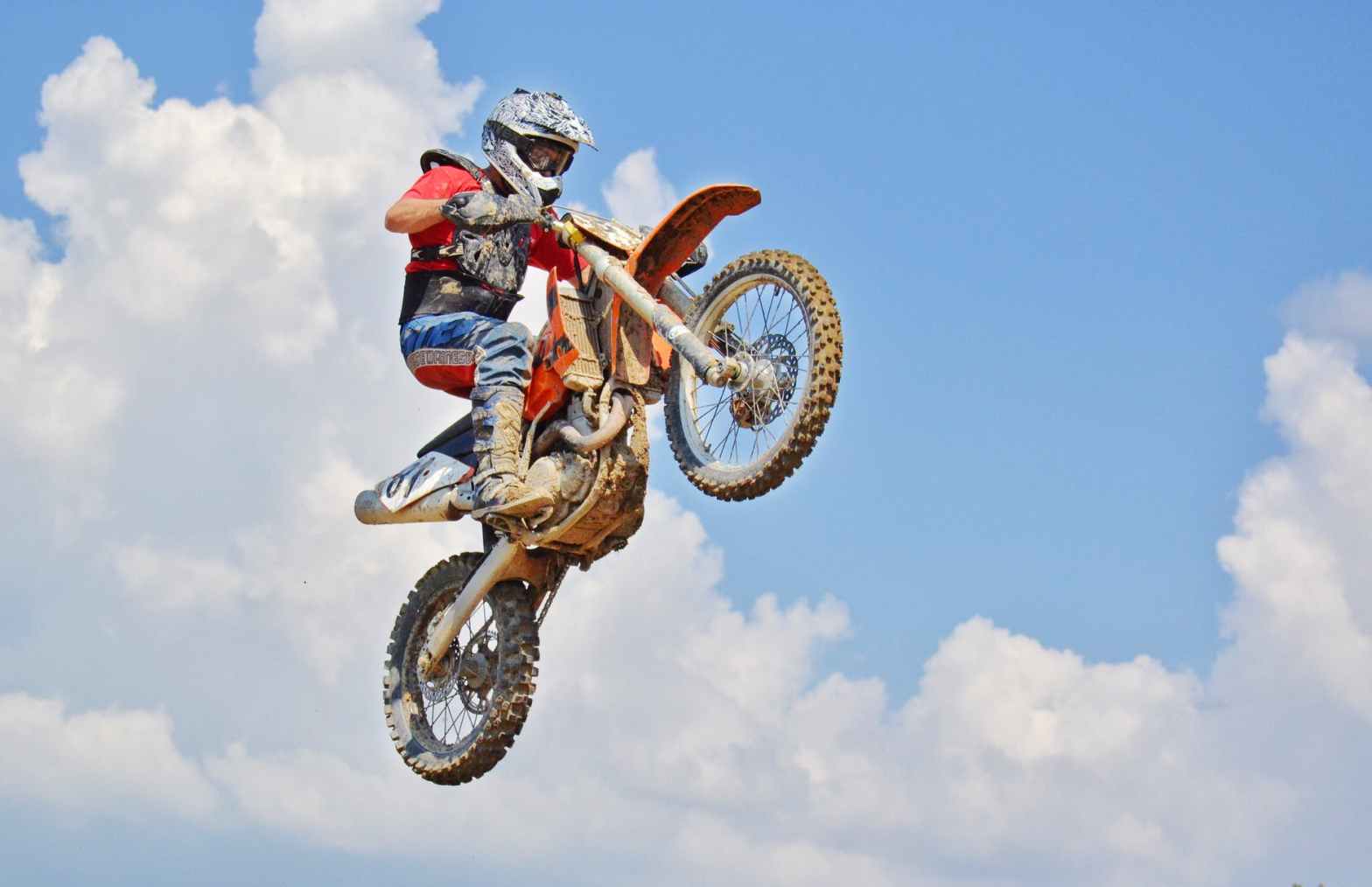
Q: A stuntman equipped with a parachute rides a bicycle over the edge of a 500.0-meter building. The combined mass of the stuntman and his bicycle is 90.0 kg. If the bike moves at 24.2 m/s as it leaves the building’s edge, at what distance from the building’s base must a cushion be placed in order to “ catch “ the daredevil?
A: We must first determine what forces ( if any ) act upon the falling object in the horizontal ( x ) and/or vertical ( y ) directions as it leaves the building’s edge. In the absence of an unbalanced force, an object will remain at rest or move with a constant velocity ( v ) with respect to an observer. Whenever unbalanced forces do act upon an object, its velocity will change at a constant rate ( a = Δv/Δt ). Additionally, we must use the building’s height ( y ) to determine how long it takes the daredevil to reach the earth’s surface:

Neglecting wind resistance, the only unbalanced force acting on the system after takeoff is the gravitational force of attraction ( Fw ); therefore, the distance traveled per second increases at a steady rate in the y-direction. Within this system, unbalanced forces do not influence the rate of travel in the x-direction. As a consequence, the daredevil will travel 24.2 m/s in the horizontal direction until reaching the earth’s surface. The following kinematic equation relates distance, velocity, time, and acceleration to one another:
y = voyt + ½ at2
The initial velocity in the y-direction ( voy ) is zero. Furthermore, objects near the earth’s surface accelerate at g = 9.8 m/s2. As a consequence, the equation is simplified as follows:
y = 0 + ½ gt2
y = ½ gt2
2y = gt2
2y/g = t2
t = √2y/g
t = √[ ( 2 )( 500.0 m ) ]/( 9.8 m/s2 )
t = √( 1,000 m / 9.8 m/s2 )
t = 10.1s
The horizontal distance travelled is the product of the daredevil’s velocity and time of travel:
dx = vt
dx = ( 24.2 m/s )( 10.1s ) = 244 m
 RENAISSANCE PHYSICS