Early experiments with magnetism revealed that a current-carrying wire is surrounded by circular lines of magnetic flux ( ɸ ). The orientation of this field could be predicted via usage of the Right-Hand Rule. These observations are indeed interesting, and they were made when the current ( I ) passing through a conductor was constant; however, things began to get really interesting when observations were made for conductors that carried changing magnitudes of current. As it turns out, a changing current gives rise to a changing magnetic field ( B ), which in turn gives rise to a changing electric field ( E ). Each of the aforementioned fields travel outward to a further extent than the field that “ created “ it. Furthermore, these electromagnetic waves move outward at the speed of light ( c = 3.0 x 10⁸ m/s ), and they are oriented at 900 angles to one another. The ultimate consequence of these observations was the merging of ideas surrounding electric current, magnetism, magnetic fields, electric fields, and light!!! In order to fully appreciate these developments, we must study the type of systems that provided such insight to researchers of the time: let’s begin with an examination of the physics regarding a charging capacitor:

Note: The earliest experiments with magnetism were carried out with loops of wire and electric current, but a capacitor will suffice as one of the tools we use to examine the fundamental concepts at hand.
When a changing magnitude of current charges a capacitor’s plates, circular lines of magnetic flux that extend outward from the E-Field region within the capacitor’s gap. These lines of flux have the same orientation as the wires that charge the associated capacitor plates. As the capacitor plates acquire more charge, it is as if the emerging electric field, somehow or another, acts as a substitute for current. As we shall see, this makes the Right-Hand Rule extremely useful in determining the direction in which an induced current will travel within a coiled system.
The actual laboratory equipment and experimental techniques used to arrive at such conclusions can be expanded upon by studying the work of the great experimentalist Michael Faraday. Faraday’s elegant approach included usage of a loop of soft iron around which two separate loops of conducting wire were wrapped, one on one side and the other positioned opposite to it:

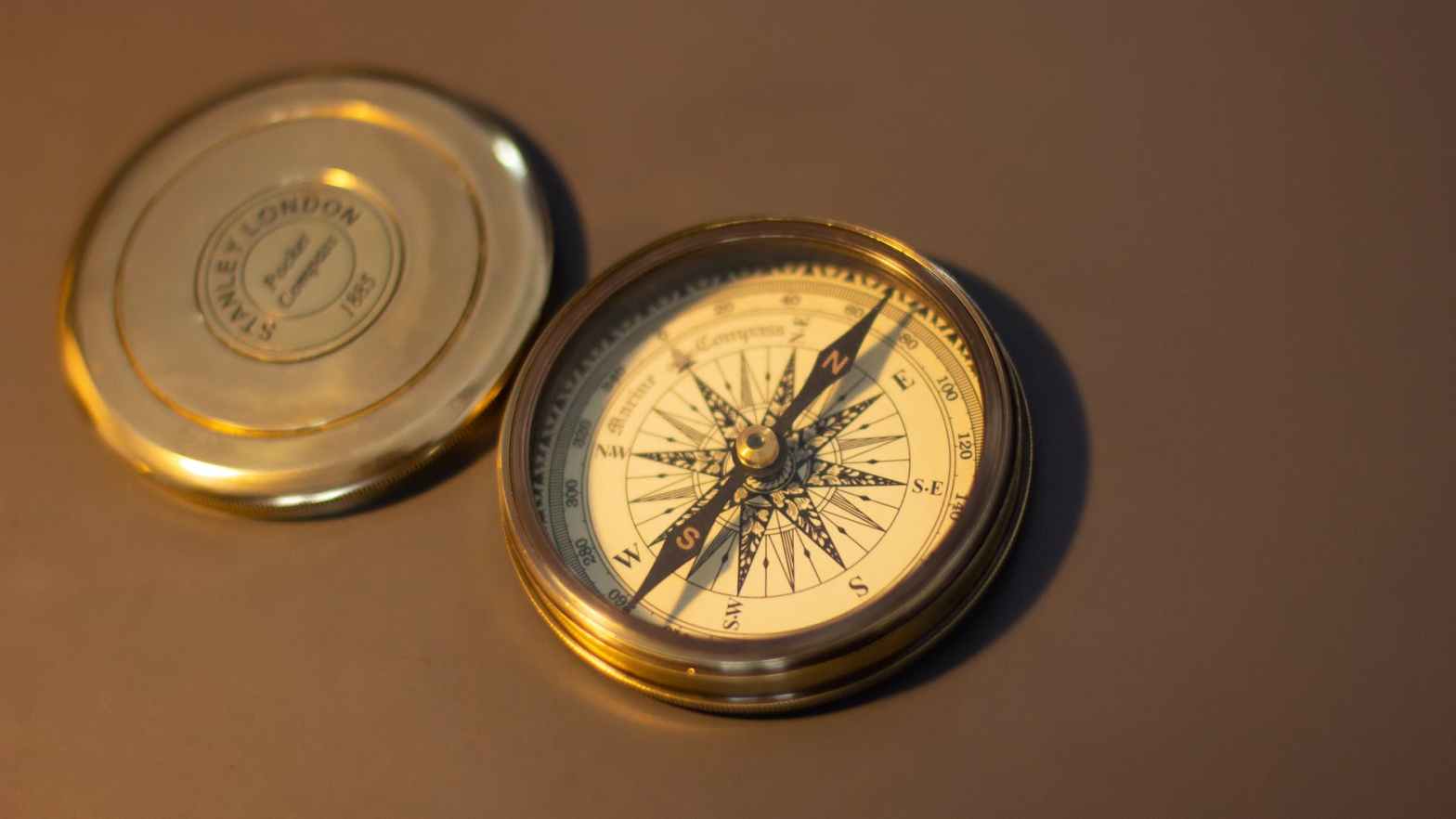
During the brief period of time when the battery’s current is increasing ( or decreasing ), a changing magnetic field will be induced within the loop. If a current is induced in the opposite wire loop, it will be detected by an appropriately positioned compass needle. This is indeed the observation that Faraday made within his laboratory setup.
In the midst of these revolutionary experiments, a question of symmetry emerged; if changing currents give rise to changing magnetic fields that themselves have the ability to induce current in a conductor, could a permanent magnet be used to accomplish the same feat??? If so, is it reasonable to believe that the rate at which a permanent magnet travels through a wire loop influences the magnitude of current that is induced??? The answer to both these questions is “ yes “. Prior to seeing how this occurs, it will be useful to review Newton’s Third Law:
“ Every force is accompanied by an equal and opposite force. “
Please recall that a bar magnet will be impacted by an equal and opposite force from another magnet if if the same poles within each magnet comprise the approaching ends:

When a bar magnet is immersed in a wire loop at a changing rate of speed, it elicits forces upon atoms that in turn give rise to a current. During this journey, it is as if the space within the loop acquires the characteristics of an opposing magnet. This creates a resistive force that opposes the forward ( or reverse ) motion of the magnet, and this force is called the electromotive force or emf ( Ɛ ):
Ɛ = – NΔɸ/Δt
The negative sign is symbolic of repulsion, and the change in magnetic flux per unit time is introduced into the system by the accelerating magnet. The N-variable refers to the number of loops present in the system. The B-Field that emerges within the midst of the loop is oriented in the way that a repulsive magnet’s B-Field would be oriented if present:

Finally, in what direction will the induced current travel??? Recall the diagram of the charging capacitor. When the Right-Hand Rule is used in that scenario, the thumb points in the direction of the current. In the diagram above, the appropriate left-to-right curvature of the emerging B-Field is the same as a current moving upward in the leftmost region of the wire. For this reason, the induced current will move upward through the leftmost wire as the bar magnet enters the loop, and it will reverse when the magnet is extracted from the loop:

 RENAISSANCE PHYSICS