
Q: A 25.0 kg grindstone disc with a 0.250 m radius ( r ) rotates with an angular speed ( ω ) of 30.0 rad/s. When power to the disc is shut off, it decelerates and comes to rest over the course of 20.0 s. When the grindstone is shut off, a speck of dust is located 0.200 m from the axis of rotation. What is the linear velocity ( vT ) of the speck when ( ω ) is 15.0 rad/s? What is its tangential acceleration ( aT ) at this moment? Additionally, what is the magnitude of the frictional force ( Ff ) that provides the torque ( 𝞃 ) needed to bring the grindstone to rest if it can be modeled as a force acting tangentially at a distance of 0.0450 m from the axis of rotation?
A: Let’s first determine the value for the tangential velocity ( vT ) in relation to its angular velocity ( ω ) component of the system:
vT = rω
vT = ( 0.200 m )( 15.0 rad/s )
vT = 3.00 m/s
Note: The instantaneous tangential force ( FT ) acting on a rotating surface’s edge is not the only force at work. A centripetal ( center seeking ) acceleration occurs when a velocity vector has its motion directed inward. As such, a centripetal acceleration ( ac ) is proportional to a centripetal force ( Fc ) that changes the direction of a linear velocity vector:
v = rω
v2 = r2ω2
( v2 / r ) = ac = rω2
With this being stated, the force of friction ( Ff ) acts tangent to the system, and it gives rise to a torque ( 𝞃 ) that opposes the rotation of the system at hand. In order to solve the problem, we must first derive an expression that relates tangential acceleration ( aT ) to the angular acceleration ( α ) of the system. Once we determine an expression for angular acceleration, we will derive an expression that relates angular acceleration to torque. Angular acceleration is related to the tangential component of acceleration ( aT ) in the following manner:
vT = rω
( Δv / Δt ) = r( Δω / Δt )
The change in magnitude of the velocity ( Δv ) in question over time ( Δt ) quantifies the acceleration ( aT ) component of the force acting tangent to the system’s surface:
aT = ( Δv / Δt )
Substitution sets the two previous equations together as one:
aT = r( Δω / Δt )
The change in magnitude of the angular speed ( Δω ) in question over time ( Δt ) quantifies the angular acceleration ( α ) of the system:
α = ( Δω / Δt )
Finally, we arrive with an expression that relates tangential acceleration to angular acceleration:
aT = rα
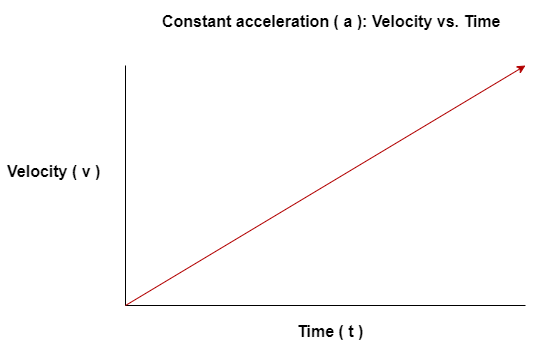
In order that we use an appropriate value for ( α ), we must know how much time ( t ) has transpired up to the point in question. It took 20.0 s for the system to go from 30.0 rad/s to rest. If the deceleration that transpires is constant, 10.0 s will have passed when the system is rotating at 15.0 rad/s: The rotational acceleration ( α ) is the rate which angular velocity ( Δω ) changes over time ( Δt ):
α = ( Δω / Δt )
α = [ ( ωf – ωi ) / Δt ]
α = [ ( 15.0 rad/s – 30.0 rad/s ) / 10.0 s ]
α = [ ( – 15.0 rad/s ) / 10.0 s ]
α = – 1.50 rad/s2
Check: Since acceleration is constant throughout, the angular deceleration that occurred over the course of time needed to come to rest should be the same value:
α = ( Δω / Δt )
α = [ ( 0 rad/s – 30.0 rad/s ) / 20.0s )
α = – 1.5 rad/s2
Let’s now solve for ( aT ):
aT = rα
aT = r( – 1.50 rad/s2 )
aT = ( 0.200 m )( – 1.50 rad/s2 )
aT = – 0.300 m/s2
We are now ready to calculate the magnitude of the torque imparted onto the system by the frictional force acting tangent to it:
Ff = FT
FT = maT
aT = rα
FT = mrα
Ff = mrα
By multiplying the magnitude of the force tangent to the system by its radial distance from the system’s center, we arrive at an expression for the torque ( 𝞃 ) of the system:
Ffr = 𝞃
Ffr = r( mrα ) = 𝞃
Ffr = mr2α
The ( mr2 ) term is the moment of inertia ( I ) of the system; it is the rotational equivalent of mass:
I = mr2
As a consequence, the product of multiplying ( I ) and ( α ) determines the magnitude of torque that a system is able to impart upon another system, or likewise, it determines how much torque is needed to decelerate another system to rest:
𝞃 = Iα
Ffr = Iα
We must be sure to use the moment of inertia value for a disc as we determine the magnitude of the frictional force that opposes the systemic torque:
Idisk = ½ mr2
Ffr = ( ½ mr2 )α
Ff = ( ½ mr )α
Substitution of appropriate values will enable us to solve for our unknown value:
Ff = ( ½ 25.0 kg )( 0.200 m )( – 1.5 rad/s2 )
Ff = – 3.75 N
 RENAISSANCE PHYSICS