
Oftentimes in physics, distinctions must be made between phenomena that have a measurable magnitude vs. those that possess both a magnitude and direction. Things that are quantified by magnitude only are referred to as scalar quantities. A scalar quantity describes a measured quantity of something that is unaccompanied by an assigned direction of choice:
Ex: distance; time; speed; mass; volume; density, energy; temperature; pressure; power
When a location is described as being “ a mile away “ from a given point of reference, it regards a distance that exists as a scalar quantity until it is assigned a specific direction ( Ex. northwest ). A gallon of gas possesses a quantity of mass ( kg ) within a given volume ( V ), aka “ density ( ⍴ ) “. It also possesses some measure of potential energy measured in joules ( J ), a temperature [ Fahrenheit ( o F ), Celsius ( o C ), or kelvin ( K ) ], vapor pressure measured in pascals ( Pa ), and the ability to provide a given amount of energy to a motor at a measurable rate referred to as “ power “ ( W ). Additionally, a full day contains a quantity of time equal to 3600 seconds ( s ). The measurements ( magnitudes ) of these quantities are described without regard to a direction ( Ex. northwest seconds is meaningless ).
To the contrary, a vector quantity is one that can be assigned both a magnitude and a direction:
Ex. displacement; spin; torque; velocity; momentum; acceleration; force
For example, displacement regards the net change in position from a point of reference after some distance has been travelled. If an object travels some distance and returns to its origin, its net displacement will be zero. To the contrary, if an object travels some distance away from a chosen point of reference without returning to its initial position, its net displacement will have a non-zero value.
When a stationary basketball player dribbles a basketball, it is initially launched forcefully downward from the player’s hand, and it eventually reaches the court beneath it. As the ball completes a cycle, it returns to a location that is approximate to its origin. The net distance the ball has travelled is a positive scalar quantity; however, since the ball has returned to its point of reference, its net displacement is zero. The motion of a pendulum on a grandfather clock is curvilinear, and it travels some predictable distance as it completes a full cycle. It too, however, has a net displacement of zero when it returns to some original point of reference along the path it travels.
It is important to note that a chosen point of reference is completely arbitrary in regard to the initial and final position of an object. In regard to a pendulum, the point of reference could be one of the two crest ( high ) positions encountered as the pendulum completes a cycle; it could be the central trough ( low ) position midway between the two crest positions; it could also be anywhere between these points.
Needless to say, many objects engage in motion that is not periodic, as is the case with a baseball that is batted out of the ball park. In this circumstance, the ball travels some distance away from a chosen origin ( the pitcher’s hand, the batter’s bat, etc. ), and if we choose a fan’s glove as our final position, the baseball will have a non-zero net displacement. If we choose the pitcher’s glove as our point of reference, that same baseball will have a net displacement of zero when it returns to the pitcher’s glove.
Mathematically speaking, there must be some scheme that is devised to make distinctions between scalar and vector quantities. This is accomplished by assigning a positive or negative value to numbers or variables that describe vector quantities:
Ex. A distance of 5m ( scalar ); A displacement of + 5m or – 5m ( vector )
For simplicity, the positive sign is generally omitted, and the absence of a negative sign designation indicates that some vector value is positive:
Ex. A speed ( s ) of 4 m/s ( scalar ); A velocity ( v ) of 4 m/s or – 4 m/s.
It is sometimes convenient to graphically assign vectors to objects for visual clarity. Consider the horizontal line below and its zero marker as a starting point of reference:
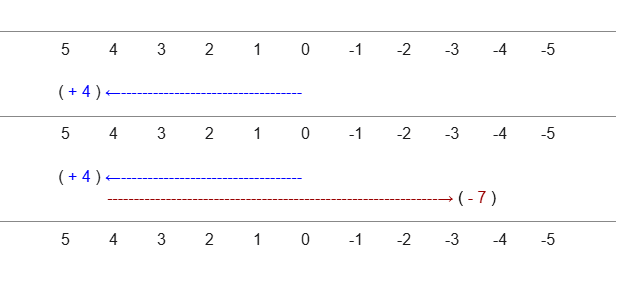
As far as distance is concerned, we initially moved 4 units away from the origin, and we subsequently moved 7 units in the opposite direction. In total, we travelled a distance equal to 11 units:
4 + 7 = 11
As far as displacement is concerned, we initially moved 4 units in the positive ( + ) direction away from the origin. We then moved 7 units in the negative ( – ) direction. Using the now-familiar rules of algebra, our net displacement is:
4 + ( – 7 ) = – 3
or
4 – 7 = – 3
Nonetheless, distinctions between vector vs. scalar quantities can be tricky at times:
Q: Is – 5 oC a scalar or vector quantity???
A: scalar
We have a negative sign here to indicate a temperature that is lower than 0 oC be 5 degrees, but “ lower than “ here isn’t the same as “ beneath “ in a directional sense ( Ex. The cat is beneath the couch ). Rather, – 5 oC describes a physical condition that can exist within a given region of space, and it is therefore a scalar quantity.
Finally, vectors will not always conveniently align with the positive and negative ( x ) and ( y ) axis. Vectors also exist in two as well as three dimensional space ( x, y, z and – x, – y, and – z axes ), and their analysis involves the clever usage of trigonometry.
“ Inch by inch is a cinch; you will get there!!! “
#LiberianMathScienceandEngineeringScholars
 RENAISSANCE PHYSICS