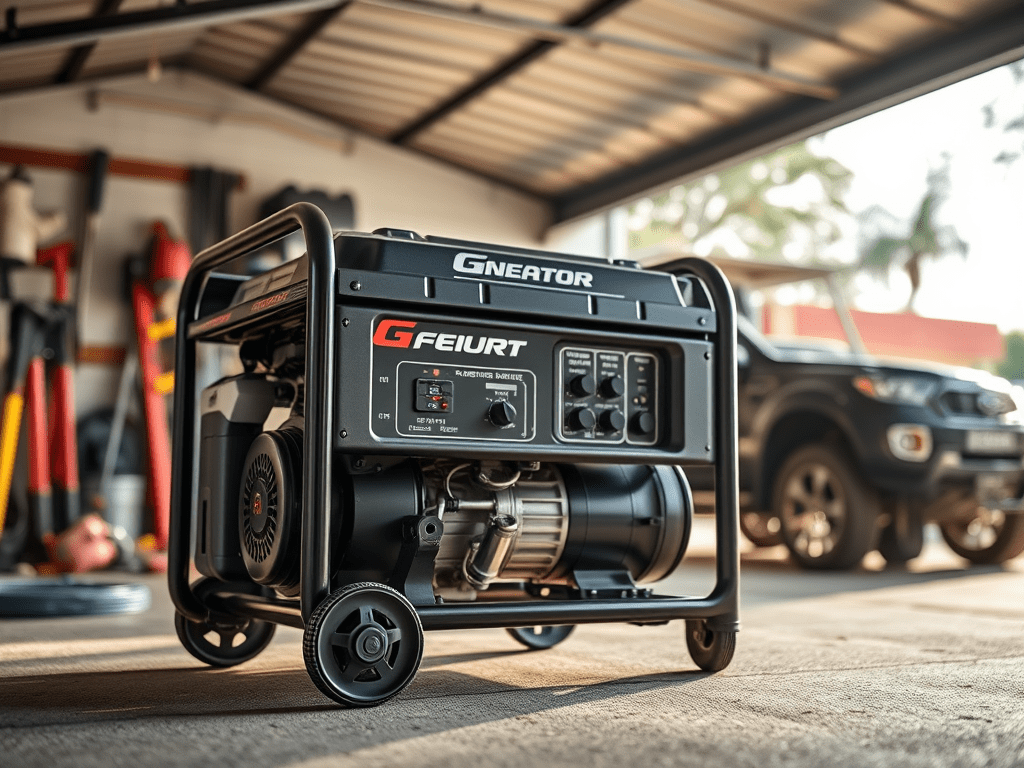
6,000 Watt Craftsman Generator Instructions: This covers most of the important steps, but other procedures regarding troubleshooting and periodic maintenance can be found within the Craftsman operator’s manual ( https://www.craftsman.com ) From this point onward, we all need to try to get cheap tents that are small enough for 1 person per person in ourContinue reading “SPECIAL TOPICS: 6,000 Watt ( W ) Craftsman Generator Instructions”
Category Archives: Electricity
MAGNETISM AND ELECTROMAGNETISM: Lenz’ Law

Q: A loop that consists of 200 ( N ) turns and an area ( A ) of 0.25 m2 is located in a downward-directed magnetic field ( B ) of 0.40 T. Additionally, the loop’s coils have a resistance ( R ) of 5.0 Ω. If the coils are crushed to an area ofContinue reading “MAGNETISM AND ELECTROMAGNETISM: Lenz’ Law”
MAGNETISM AND ELECTROMAGNETISM: Electromagnetic Induction and the Electromotive Force ( emf )

Q: A metallic coil that consists of 200 ( N ) turns encloses an area ( A ) of 100 cm2. The coil is placed within a magnetic field ( B ) that is perpendicular to its area, and it has a magnetic flux density of 0.50 T. Next, the field is shut off, andContinue reading “MAGNETISM AND ELECTROMAGNETISM: Electromagnetic Induction and the Electromotive Force ( emf )”
INTRODUCTION TO ELECTRONICS: Conventional Current, Kirchhoff’s Laws, Magnetic Fields, and the Right-Hand Rule

Conventional current refers to the convention in which electrical current ( I ) is considered to be a flow of positive charges. The usefulness of this convention is readily observable when dealing with Kirchoff’s Laws ( or Rules ) and the analysis of magnetic fields that encircle a conductor that carries a conventional current. OfContinue reading “INTRODUCTION TO ELECTRONICS: Conventional Current, Kirchhoff’s Laws, Magnetic Fields, and the Right-Hand Rule”
INTRODUCTION TO ELECTRONICS: DC Motors

We have seen how a conducting wire moving with respect to an electric field ( B ) will experience forces upon its electrons. Consider the diagram below: Due to the proper ( perpendicular ) alignment of the loop and magnetic field, the maximum amount of DC current will be produced; however the voltages and currentsContinue reading “INTRODUCTION TO ELECTRONICS: DC Motors”
INTRODUCTION TO ELECTRONICS: DC Generator Fundamentals

In order to understand how DC generators produce electricity, it is crucial to understand how the relative motion of a conductor moving through a magnetic field ( B ) induces forces that put the conductor’s electrons into motion; however, prior to engaging in a discussion about electromagnetic induction, we must briefly re-examine how the magneticContinue reading “INTRODUCTION TO ELECTRONICS: DC Generator Fundamentals”
INTRODUCTION TO ELECTRONICS: Magnetic Field Intensity and Hysteresis

Please recall that the magnetomotive force ( Fm ) equation shows how the magnitude of current ( I ) flowing through ( N ) loops of wire determine how much flux ( ɸ ) is established within a metal core around which the wire is wrapped: Fm = NI It is important to remember thatContinue reading “INTRODUCTION TO ELECTRONICS: Magnetic Field Intensity and Hysteresis”
INTRODUCTION TO ELECTRONICS: Electromagnet Fundamentals

Thus far, we’ve seen how charge ( q ) in motion has the ability to give rise to magnetic fields ( B ) within certain material types. It will now be useful to see how certain rules are used to determine which direction this magnetic flux ( ɸ ) will travel within a given magneticContinue reading “INTRODUCTION TO ELECTRONICS: Electromagnet Fundamentals”
INTRODUCTION TO ELECTRONICS: The Magnetomotive Force

The relationship between cause, effect, and resistance ( R ) to change are beautifully summed up by the Ohm’s law equation: ( V / R ) = I The greater the ability a system has to resist change, the less so that change will be observed. As far as Ohm’s law is concerned, change isContinue reading “INTRODUCTION TO ELECTRONICS: The Magnetomotive Force”
INTRODUCTION TO ELECTRONICS: Reluctance and Permeability of Magnetic Materials

Q: A blacksmith splits open a doughnut-shaped torus as pictured below: The inner radius of the torus is 1.75 cm, and the outside radius is 2.25 cm. If the torus is made of low-carbon steel, what is its reluctance? A: Let’s begin by viewing the torus from above prior to being split apart: The threeContinue reading “INTRODUCTION TO ELECTRONICS: Reluctance and Permeability of Magnetic Materials”
 RENAISSANCE PHYSICS